Advanced topics
GeoNetwork API
In recent releases most of GeoNetworks functionality is exposed via a centralised API based on OpenApi. An optimal approach to get started with the API is via the Interactive documentation page provided by OpenAPI. This page is accessibly via http://localhost:8080/geonetwork/doc/api.
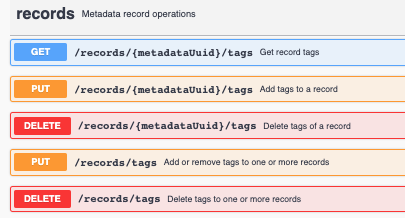
The page describes each of the methods and its properties, but also offers the capability to try out any operation via a web form.
Kibana Dashboard
Kibana is an optional component which can be installed with Elasticsearch. Kibana offers a dynamic way to create visualisations of the content of the Elasticsearch index.
The GeoNetwork community has prepared some sample visualisations. Load the samples from export.ndjson via the Saved objects → Import option in Kibana.
If installed, you can access Kibana from the GeoNetwork admin interface. To access the Kibana interface you need to be logged in as administrator.
Read more about the usage of Kibana at the Kibana introduction.
Search engines
Search engines provide a good mechanism for wide data discovery for public portals. The process of having catalogue content ingested by search engine crawlers requires some attention. The search engine expects to find robots.txt, at the root of the domain. The catalogue provide a robots.txt file at http://localhost:8080/geonetwork/srv/api/robots.txt.
User-agent: *
Disallow: /geonetwork/catalog/
Disallow: /geonetwork/static/
Sitemap: http://localhost:8080/geonetwork/srv/api/sitemap
This file contains references to the sitemap which register all record landing pages available for indexing. The sitemap is paginated if needed. For better indexing, you may need to register the sitemap manually at individual search engines.
<urlset xmlns="http://www.sitemaps.org/schemas/sitemap/0.9" xmlns:xsi="http://www.w3.org/2001/XMLSchema-instance" xmlns:dct="http://purl.org/dc/terms/" xsi:schemaLocation="http://www.sitemaps.org/schemas/sitemap/0.9 https://www.sitemaps.org/schemas/sitemap/0.9/sitemap.xsd">
  <url>
    <loc>http://localhost:8080/geonetwork/srv/api/records/da165110-88fd-11da-a88f-000d939bc5d8?language=all</loc>
    <lastmod>2024-06-04</lastmod>
  </url>
GeoNetwork includes a representation of the sitemap record in schema.org (Structured Data for the Web) framework:
-
Published metadata record accessed through sitemap / GeoNetwork API as HTML include
json-ldlinked data (embedded JSON in the HTML page as a script element). -
The included
json-lduses vocabulary from schema.org and also the Croissant extension for machine learning.Croissant 🥐 is a high-level format for machine learning datasets that combines metadata, resource file descriptions, data structure, and default ML semantics into a single file; it works with existing datasets to make them easier to find, use, and support with tools. Croissant builds on schema.org, and its Dataset vocabulary, a widely used format to represent datasets on the Web, and make them searchable.
Croissant is used to cover data model aspects (ISO19110) and additional details about distributions not covered by schema.org.
This enables the search engine to extract the information in a structured way.